Modern vehicle development relies heavily on robust communication networks such as CAN, CAN FD, LIN, and increasingly CAN XL. Engineers working in ECU development, diagnostics, calibration, validation, and HIL testing require reliable interfaces that provide fast access to these vehicle networks.
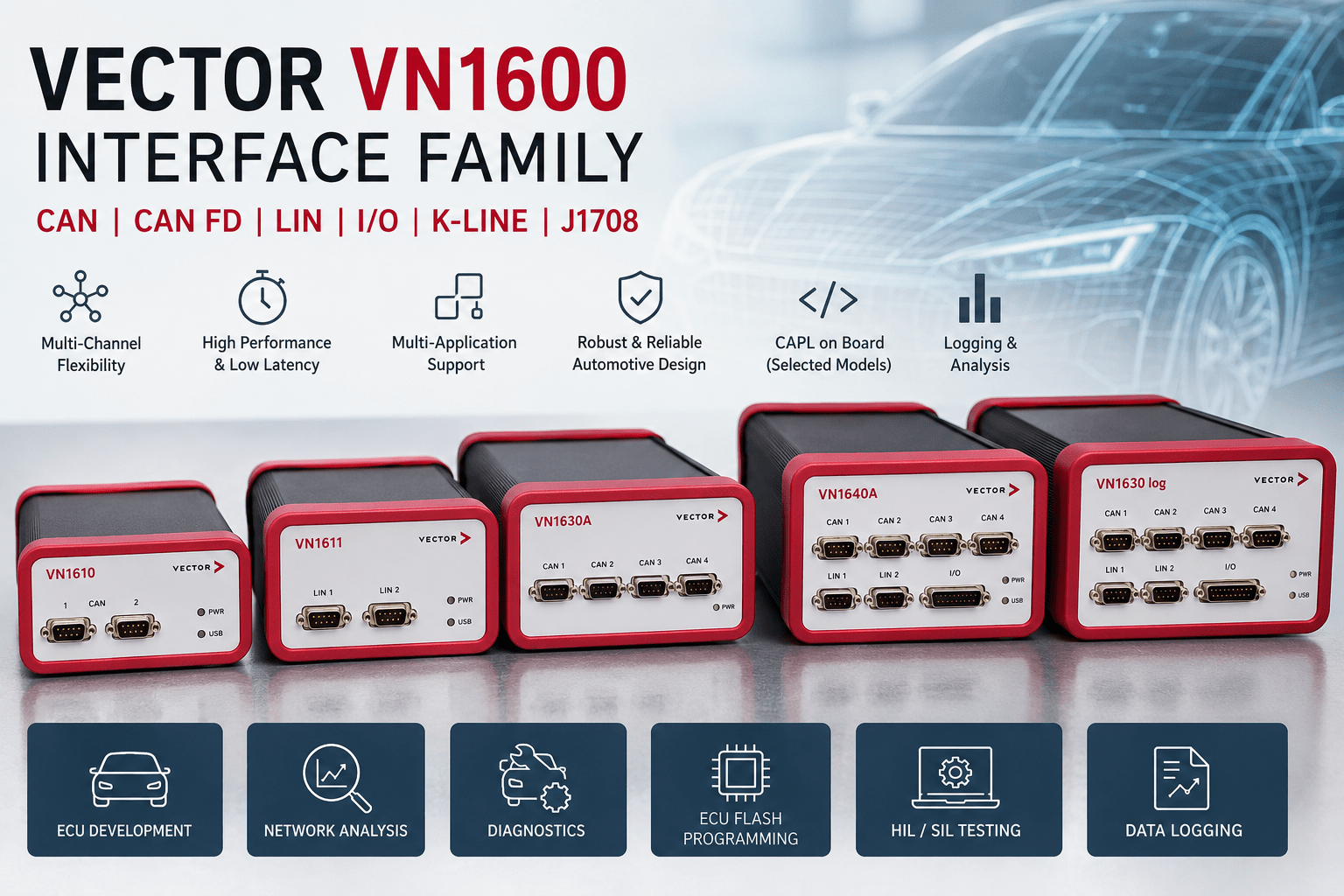
The Vector VN1600 Interface Family is one of the most widely used network interface platforms in the automotive industry. Designed for use with tools such as CANoe, CANalyzer, CANape, vFlash, and custom applications, the VN1600 series offers a flexible and scalable solution for CAN, CAN FD, LIN, K-Line, J1708, and I/O applications.
Overview of the VN1600 Family
The VN1600 family consists of several models designed for different application requirements:
| Model | Channels | Key Features |
|---|---|---|
| VN1610 | 2 CAN/CAN FD | Compact and lightweight |
| VN1611 | 2 LIN | Dedicated LIN interface |
| VN1630A | Up to 4 CAN/CAN FD/LIN | Modular transceiver concept |
| VN1640A | 4 CAN/CAN FD/LIN + I/O | Advanced I/O functionality |
| VN1630 log | 4 CAN/CAN FD/LIN | Integrated logging capability |
The family is designed to provide synchronized communication channels with low latency and high-precision timestamping for demanding automotive applications.
Key Features
1. CAN and CAN FD Support
The VN1600 interfaces support:
- Classical CAN
- CAN FD (Flexible Data Rate)
- High-speed CAN communication
- Hardware-assisted ECU flashing
CAN FD significantly increases throughput by allowing larger payloads and higher data rates compared to Classical CAN. The VN1600 family supports CAN FD data rates up to 8 Mbit/s.
2. LIN Support
Several VN1600 models support:
- LIN 1.x
- LIN 2.x
- SAE J2602
Advanced LIN stress testing capabilities make these interfaces particularly useful for LIN conformance testing and network validation.
3. Multi-Application Access
One of the strongest capabilities of the VN1600 family is Multi-Application Support, allowing multiple software applications to access the same hardware simultaneously.
Examples:
- CANoe + CANape
- CANalyzer + vFlash
- Custom applications using XL Driver Library
This feature improves engineering productivity by eliminating the need for multiple interfaces.
4. Precise Time Synchronization
The interfaces provide:
- Hardware timestamping
- Channel synchronization
- Low latency communication
This is critical for applications such as:
- ECU calibration
- ADAS testing
- Functional safety validation
- Network analysis
VN1610 – Compact CAN FD Interface
The VN1610 is the most compact member of the family and is ideal for mobile use, vehicle testing, and service applications.
Technical Specifications
| Parameter | VN1610 |
| CAN Channels | 2 |
| CAN FD Support | Yes |
| USB Interface | USB 2.0 |
| Power Supply | Via USB |
| Synchronization | Software Sync |
| Transceiver | Integrated High-Speed CAN |
Typical Applications
- CAN bus monitoring
- ECU diagnostics
- Calibration tasks
- Flash programming
- Service engineering
Its small form factor makes it especially suitable for in-vehicle measurements and field testing.
VN1630A – Flexible Multi-Channel Interface
The VN1630A is designed for engineers requiring higher channel counts and greater flexibility.
Technical Specifications
| Parameter | VN1630A |
| Channels | Up to 4 |
| CAN FD Support | Yes |
| LIN Support | Yes |
| K-Line Support | Optional |
| Digital I/O | Yes |
| Analog I/O | Yes |
| USB Connectivity | Yes |
| CAPL on Board | Yes |
Advantages
- Modular transceiver (“Piggy”) architecture
- CAN, LIN, K-Line flexibility
- CAPL execution on the device
- Advanced test automation support
The configurable transceiver concept allows engineers to adapt the interface to specific project requirements.
VN1640A – High-End CAN/LIN Interface
The VN1640A is targeted at advanced development and testing applications.
Technical Specifications
| Parameter | VN1640A |
| CAN/CAN FD Channels | 4 |
| LIN Support | Yes |
| Digital I/O | Yes |
| Analog I/O | Yes |
| USB Connectivity | Yes |
| Synchronization | Hardware-based |
| CAPL on Board | Yes |
Application Areas
- HIL testing
- ECU validation
- Network simulation
- Remaining bus simulation
- Automated testing
The additional I/O capabilities make the VN1640A particularly useful for interacting with external signals and test benches.
VN1630 log – Logging and Analysis
The VN1630 log combines the communication capabilities of the VN1630A with integrated data logging functionality.
Key Benefits
- Standalone data recording
- CAN/CAN FD logging
- LIN logging
- I/O recording
- Configuration through Vector Logger Configurator
This interface is ideal for vehicle fleet testing, durability testing, and long-term data acquisition.
Typical Automotive Applications
ECU Calibration
Used with calibration tools to:
- Read measurement variables
- Modify calibration parameters
- Record ECU data
Network Analysis
Combined with CANoe or CANalyzer for:
- Bus monitoring
- Signal decoding
- Error analysis
- Performance evaluation
ECU Flash Programming
The hardware-assisted flash implementation significantly reduces ECU programming time during development and production validation.
HIL and SIL Testing
The interfaces are widely deployed in:
- Hardware-in-the-Loop systems
- Software validation platforms
- Automated regression testing
Comparison of Popular VN1600 Models
| Feature | VN1610 | VN1630A | VN1640A | VN1630 log |
| CAN FD | Yes | Yes | Yes | Yes |
| LIN | No | Yes | Yes | Yes |
| I/O Support | No | Yes | Yes | Yes |
| Logging | No | No | No | Yes |
| CAPL on Board | No | Yes | Yes | Yes |
| Best For | Diagnostics | Development | Validation | Vehicle Testing |
Why the VN1600 Family Remains an Industry Standard
The VN1600 series has become a standard interface family in automotive development because it combines:
- Reliable hardware
- Excellent CAN FD performance
- Flexible channel configurations
- Multi-application support
- Tight integration with Vector software tools
- Scalable architecture from 2-channel to advanced multi-channel systems
Whether the task involves ECU calibration, CAN bus analysis, diagnostics, flashing, or HIL testing, the VN1600 family provides a proven and highly capable solution for automotive engineers.
Conclusion
As automotive networks continue evolving toward CAN FD and CAN XL, development engineers need interfaces capable of handling higher bandwidths, complex testing requirements, and synchronized measurements. The Vector VN1600 family successfully addresses these needs through a versatile range of interfaces that support everything from simple CAN monitoring to advanced vehicle validation and data logging applications.
For engineers working in ECU development, testing, calibration, and diagnostics, the VN1600 family remains one of the most dependable and widely adopted interface solutions available today.